Corporate E-Waste Disposal & Electronic Recycling in Malaysia

Promoting Malaysia's circular economy through refurbishment, reuse and responsible recycling via our network of DOE-licensed recycling partners.

ECO-FRIENDLY

Retired laptops, desktops, servers, monitors and other IT equipment should never end up in general waste streams. Improper disposal can release hazardous materials into the environment while valuable resources remain unrecovered.

We help Malaysian organizations manage unwanted IT equipment through a responsible e-waste process. This circular approach minimizes electronic waste, extends the life of suitable devices and reduces demand for manufacturing new equipment.

Where required, storage devices are sanitized through certified data destruction before equipment proceeds to recycling, with supporting documentation available for compliance and audit purposes.
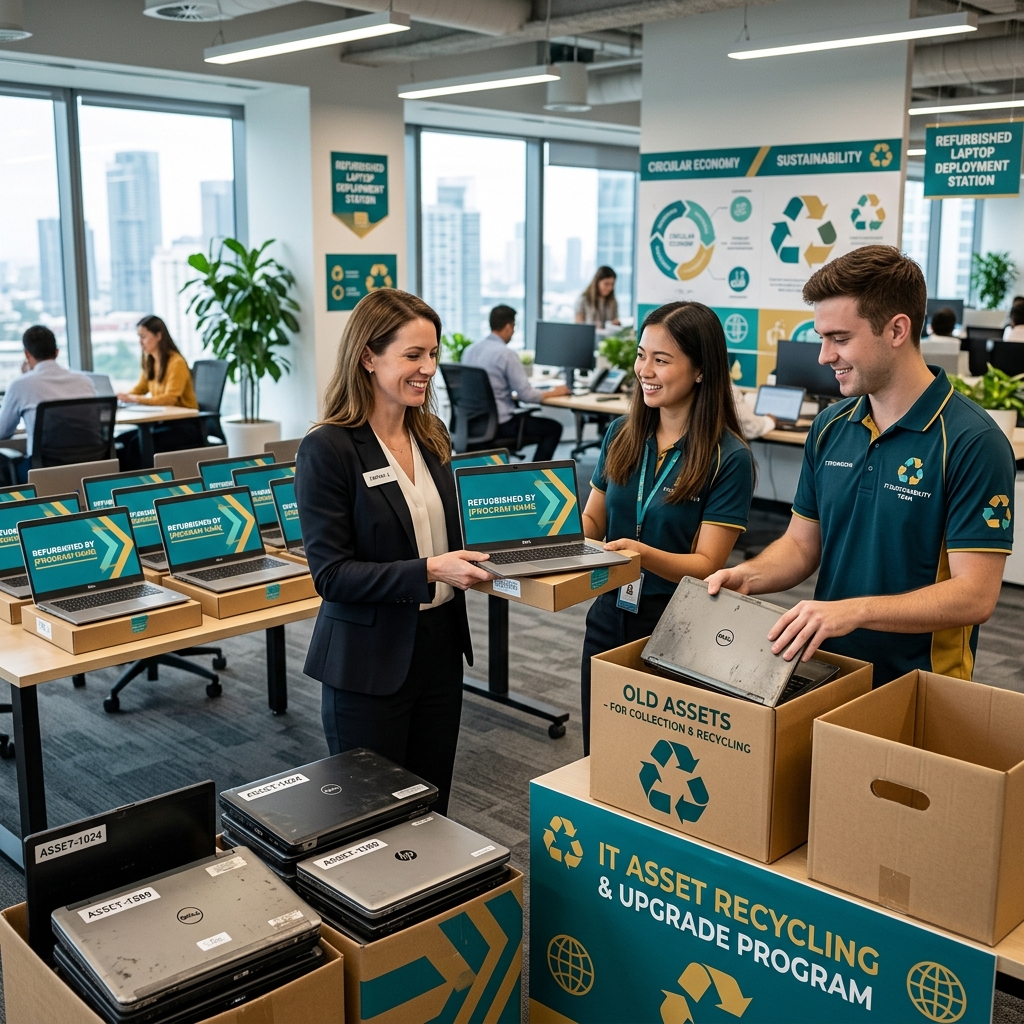
Responsible IT asset recovery and e-waste handling

Why Responsible E-Waste Recycling Matters

Electronic waste is one of the world's fastest-growing waste streams, and Malaysia continues to see increasing volumes of discarded IT equipment from businesses and organizations.

IT equipment contains recyclable materials such as steel, aluminium, copper and plastics, alongside electronic components that can be recovered for reuse. However, it may also contain hazardous substances that require specialized handling by licensed recycling facilities to minimize environmental impact.

As environmental regulations and corporate sustainability expectations continue to evolve, organizations are increasingly expected to manage electronic waste responsibly and support broader ESG and circular economy initiatives. We help businesses retire obsolete IT equipment through a structured process that prioritizes refurbishment and reuse, before coordinating e-waste recycling through our network of DOE-licensed partners. This approach helps reduce electronic waste and maximize material recovery. Supporting documentation is also provided, which organizations may use for their internal compliance and sustainability reporting.

Our Circular Economy Model

Step 1: Refurbishment First

Every collected device is assessed for refurbishment potential. Equipment that remains suitable for continued business use is restored, tested and prepared for a second lifecycle, reducing unnecessary electronic waste and extending product lifespan.

Step 2: Reuse Where Possible

Devices that are no longer suitable for premium refurbishment may still provide value in secondary markets or alternative business environments. Reuse is prioritized before recycling whenever practical to maximize resource efficiency.

Step 3: Responsible Electronic Recycling

Equipment that has reached the end of its usable life is transferred to our network of DOE-licensed e-waste recycling partners for environmentally responsible processing. Recoverable materials are separated for recycling, while regulated materials are handled in accordance with Malaysian environmental requirements.

Step 4: Documentation & Reporting

Throughout the engagement, we maintain documented asset handling records, including chain of custody records, certificates of data destruction (where applicable through certified partners), and supporting documentation for compliance and sustainability reporting.

E-Waste Management FAQs

Ethical e-waste management means retiring electronics in a way that protects data, people, and the environment: reuse first, then licensed recycling, with no dumping, no illegal export, and no landfilling of hazardous parts. In Malaysia, it’s mandatory because e-waste is classified as Scheduled Waste under code SW110 of the Environmental Quality (Scheduled Wastes) Regulations 2005, enforced under the Environmental Quality Act 1974. Companies that generate it must send it to DOE-licensed facilities using DOE-registered transporters. Improper disposal can lead to fines and imprisonment, and the generating company stays accountable even if a contractor was the one who dumped it.

Yes, every stage of our third-party-based recycling services is DOE-licensed: collection, transport (DOE-registered vehicles and drivers), and recovery at a licensed recovery facility.

We accept almost all IT equipment for recycling, but depending on the type of item, you may be asked to drop it off at one of our authorized third-party recycling sites.

If you’re unsure whether a specific item is accepted, contact us with the item details and we’ll guide you on the right drop-off option.

Our process is built to avoid landfill: reusable units are refurbished, and the rest is dismantled and sent to licensed recovery facilities for metals, plastics, and glass recovery. Be careful with any vendor that promises “100% zero landfill” without documentation, because residual fractions that can’t be recovered do exist. What matters is a documented downstream trail showing where each material stream went, and that is included in your final report.

They are separated at dismantling and handled as scheduled waste. Batteries (lithium-ion, NiCd) are removed first, since they are a fire risk and fall under their own scheduled waste code. Mercury-containing parts (older backlights), leaded CRT glass, and circuit boards are sent to licensed facilities equipped to recover or safely treat them. None of it goes into general waste.

Refurbishment/reuse keeps the whole device in use after data wiping, testing, and repair. It retains the most value and has the lowest environmental impact. Scrap recycling breaks the device into raw materials (metals, plastics, glass) and recovers them, which is the right route only when a device is beyond economic repair. Reuse comes first, recycling second.

Drives that fail or can’t be reliably wiped are removed and physically destroyed by shredding or degaussing (HDDs), since software wiping can’t be verified on them. Each drive is logged by serial number, tracked under chain of custody, and listed on your Certificate of Data Destruction as “physically destroyed” instead of “wiped.” The destroyed remains are then sent for material recovery.

Yes. On project completion, you receive a certificate of recycling/disposal, plus the supporting documents: asset inventory, chain-of-custody log, Certificate of Data Destruction, and the downstream disposition summary.

Our recycling services are available to businesses only. We work exclusively with corporate (B2B) clients and are unable to accept personal laptops or other items from individuals.

Depending on the type of items, your company may be asked to deliver them directly to our third-party recycling facility. We’ll confirm this with you in advance, so you know exactly where and how to hand over your equipment.

Don’t put them in the household bin. They count as e-waste, so drop them at a registered collection point instead. The Department of Environment lists them by state, and the MyEwaste app helps you find one near you. Some electronics retailers and recyclers run take-back or trade-in schemes. Check with the outlet first, since accepted items change.

Dispose of Your Corporate E-Waste Responsibly

Whether you're replacing a few office computers or retiring an entire IT infrastructure, we'll assess your equipment, identify devices suitable for refurbishment and recommend an environmentally responsible solution tailored to your organization.